
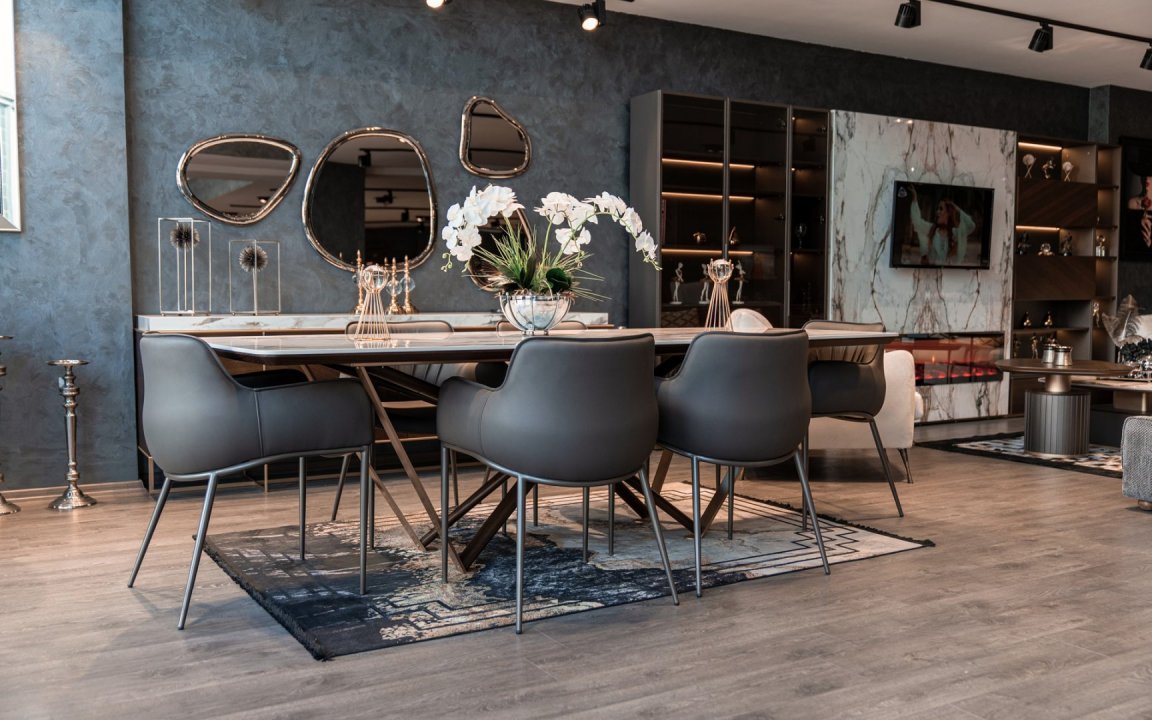
When choosing a dining table and chairs, explore the key factors to consider in terms of dimensions, materials, seating structure, color, usage area, and overall harmony with the interior decoration.
What Should You Consider When Choosing a Dining Table and Chairs?
When making a dining table and chair selection, you should consider not only the appearance of the model but also the table dimensions, chair height, seating structure, materials, colors, frequency of use, and the size of the space where the furniture will be placed. For those who want to make the right choice for a living room or dining room, the most important point is ensuring that the table and chairs are compatible both with each other and with the other furniture in the living space. Choosing the right dimensions and materials makes the dining area more functional while also strengthening decorative harmony.
A dining table is important not only for everyday use but also for hosting guests, family meals, and social gatherings. Therefore, ergonomics, ease of use, and space planning should be considered alongside aesthetics when choosing a table and chairs.
Why Should the Dining Table and Chairs Be Chosen Together?
Although the table and chairs may appear to be separate products, they function as a single system in everyday use.
If the table height, chair seat level, and knee clearance are not compatible, the dining experience may become uncomfortable.
There is also a direct relationship between the form of the table and the number of chairs.
For example, placing too many chairs with very narrow spacing around a large table may create crowding during use. Similarly, chairs with wide armrests may not be suitable for every type of table.
For this reason, dining table and chair selection should be planned together.
How Should Dining Table Size Be Determined?
The first criterion when choosing a table is the size of the available space.
It is not enough for the table to simply fit into the room. There should also be enough space for the chairs to be pulled back comfortably and for people to move around the table.
When taking measurements, the following details should be considered:
-
Total width of the room
-
Clear area allocated for the table
-
Space required for chair movement
-
Doors and circulation points
-
Console or other furniture pieces
-
Distance from walls and windows
Leaving enough space around the table is important for everyday comfort.
How Many People Should the Dining Table Accommodate?
The capacity of the table should be determined according to both the number of people living in the home and how frequently guests are hosted.
Tables for four may be suitable for more compact living spaces.
Six-person tables offer more flexible use in medium-sized living rooms and dining rooms.
Tables for eight or more people may be preferred in larger spaces.
When making a decision, consider not only the seating capacity but also the total amount of space the table occupies during use. If an extendable model is selected, both the open and closed dimensions should be evaluated separately.
How Should You Choose Between a Rectangular, Round, or Square Table?
The dining table shape should be selected according to the shape of the room and the number of users.
Rectangular Dining Table
Rectangular tables are particularly practical in long or spacious living rooms. They allow more chairs to be placed around the table and can be easily coordinated with other furniture such as consoles.
Round Dining Table
Round tables provide a more fluid layout. Since they do not have sharp corners, they can make circulation easier in small and medium-sized spaces.
They also allow people around the table to sit at a more equal distance from one another.
Square Dining Table
Square tables can be used in more symmetrical spaces. They may be suitable for smaller families or compact dining areas.
The shape of the table should always be evaluated together with the geometry of the room.
Table Height and Chair Height Should Be Compatible
One of the most important factors that determines ergonomics in a dining area is the relationship between table and chair height.
If the chair seat is too high, the user may feel restricted under the table. If it is too low, the tabletop may feel too high for comfortable everyday use.
For this reason, the following should be evaluated together:
-
Table height
-
Chair seat height
-
Thickness of the tabletop
-
Supporting structures under the table
Knee clearance should be checked especially carefully for tables with thick tops or substantial structures underneath.
How Should the Chair Seating Structure Be?
When making a chair selection, seating structure is just as important as appearance.
The chair seat should provide sufficient support for everyday use.
The main details to evaluate include:
-
Seat width
-
Seat depth
-
Backrest height
-
Backrest angle
-
Padding structure
-
Use of armrests
Chairs with proper back support may be more functional for longer meals or conversations.
Simpler models may be preferred for more decorative or shorter-term use.
Should You Choose Chairs with or Without Armrests?
Chairs with armrests may provide more support, but they also require more space.
For this reason, there should be sufficient room around the table.
Armless chairs are easier to position and can usually be pushed under the table more easily.
In smaller dining areas, armless or narrower chair designs may be more functional.
With larger tables, chairs with armrests can be used at the head positions, while armless models can be placed along the sides.
How Should Chair Fabric Be Selected?
Chair fabric should be suitable both for the intensity of use and the overall decoration of the dining area.
When making a chair fabric selection, the following criteria can be considered:
-
Ease of cleaning
-
Usage intensity
-
Weave structure
-
Color durability
-
Tactile feel
-
Compatibility with the table and other furniture
If the dining area is used intensively every day, ease of maintenance becomes more important.
In homes with children or where guests are frequently hosted, easier-to-clean fabrics may be preferred.
How Should Dining Table Materials Be Selected?
The material used on the tabletop affects both the design and the way the table is used.
Wood, MDF, lacquer, glass, and stone-effect surfaces each have different characteristics.
Wooden Table
Wooden tables create a more natural and warm appearance. Walnut, oak, and different veneer tones can be coordinated with other living room furniture.
Lacquered Surface
Lacquered surfaces create a smoother and more controlled appearance. They can be used in both modern and luxury interiors.
Glass Table
Glass surfaces can reduce visual weight. They may create a lighter effect, especially in smaller spaces.
Stone- or Marble-Effect Surfaces
These surfaces can create a stronger design character. However, they should be balanced carefully with the table legs, chairs, and other furniture.
Why Is Table Leg Design Important?
The table leg is important for both design and usability.
Traditional four-leg structures provide a more conventional seating arrangement, while central or geometric bases may allow different chair placements.
However, the table base should not interfere with comfortable chair use.
Central pedestal tables may allow more flexible chair positioning.
With larger geometric bases, knee and leg clearance should be checked carefully.
How Can Color Harmony Between the Table and Chairs Be Achieved?
The table and chairs do not need to be exactly the same color.
To create dining room color harmony, you can use:
-
The same wood tone
-
Similar fabric colors
-
A shared metal detail
-
Similar color temperatures
For example, a dark walnut table can be combined with light beige chairs and bronze details.
A light wood table can be complemented by gray, stone, or natural fabric tones.
The goal is not to use only one color, but to create a shared color system.
Do the Chairs Have to Be from the Same Collection as the Table?
No.
It is possible to use a table and chairs from different collections.
However, there should be a connection between their design languages.
This connection can be created through:
-
Leg form
-
Wood tone
-
Fabric color
-
Metal finish
-
Overall design language
This approach can help create a more personal and layered dining area.
How Can Harmony Be Achieved When the Living Room and Dining Area Share the Same Space?
In open-plan or combined living rooms, the dining table and chairs should not be considered separately from the sofa set and TV unit.
For example:
-
The metal tone used on the sofa legs can be repeated on the dining table legs.
-
The wood tone used on the TV unit can also be used on the dining table.
-
Chair fabric can be selected from one of the secondary colors used on the sofa.
These repetitions create a visual connection between the living and dining areas.
How Should a Dining Table Be Chosen for Small Spaces?
In small dining areas, dimensions become more important than the shape of the table.
In these spaces, the following can be considered:
-
More compact table dimensions
-
Round or oval forms
-
Slim-legged designs
-
Extendable tables
-
Armless chairs
Enough circulation space should also be left between the table and the wall.
Choosing an excessively large table in a small area can make everyday movement difficult.
How Should the Dining Area Be Planned in Large Living Rooms?
In spacious living rooms, the dining area can be defined more clearly.
Large tables, consoles, and wider chair groups can be used.
However, furniture should not be made unnecessarily oversized simply because the room is large.
The proportions of the table and chairs should remain compatible with the overall furniture scale of the living room.
A rug or lighting can be used to define the boundaries of the dining area.
What Kind of Relationship Should There Be Between the Dining Table and Console?
The console is generally a complementary piece of furniture in the dining area.
The table and console can share common details such as:
-
Wood tone
-
Metal details
-
Surface texture
-
Handle design
The depth of the console should not reduce the circulation space behind the dining table.
For this reason, placement is just as important as design when choosing a console.
How Does Lighting Affect Dining Table Selection?
Lighting in the dining area directly affects how the furniture is perceived.
Pendant or ceiling lighting above the table should be balanced with the shape and dimensions of the table.
Linear or multiple lighting fixtures can be used above longer tables.
Central lighting may look more balanced over round tables.
The color temperature of the lighting can also affect how wood and fabric tones are perceived.
Should a Rug Be Used in the Dining Area?
Using a rug under the dining table is not mandatory, but it can help define the area.
If a rug is used, it should be large enough for the chairs to remain on the rug even when pulled back.
Rugs that are too small may cause chairs to catch on the edges and can make the dining area appear disproportionate.
Colors that coordinate with the table and chair palette can be preferred.
Why Are Daily Usage Habits Important When Choosing a Dining Table?
A dining table is not only a decorative piece of furniture.
It may be used for everyday meals, working, hosting guests, or other activities.
For this reason, the following should be considered during selection:
-
How many people use the table regularly
-
How often guests are hosted
-
Whether the table is also used for working
-
Whether an extension mechanism is needed
-
Expectations for easy maintenance
The intended use directly affects material and dimension decisions.
Who Is an Extendable Dining Table Suitable For?
Extendable tables offer a solution that is more compact for everyday use but can accommodate more people when needed.
They may be particularly suitable for:
-
Small and medium-sized homes
-
Living spaces where guests are frequently hosted
-
Homes that do not require a large table every day
However, the total dimensions of the table in its fully extended position should be checked before purchasing.